
Vieu
Date
1 month
Client
Vieu is a tech sales startup that created a native AI stack fusing signals across the Internet, Enterprise and End-users to help clients find pre-existing (warm) connections at various target companies
Summary:
At my remote summer internship @ Vieu, I acted as a usability and design (or UX researcher) where I provided insights to the Head of Design And End of User Workflow regarding the functional and aesthetic elements drawing from client sessions and my own experience using the platform. I bridged the gap between applied cognitive psychology and visual design using various design thinking frameworks to help improve current web flow in order to increase client engagement on the platform concepts.
The Problem:
When I joined Veiu, multiple key regions of the platform were being underutilized by clients such as the main administrative and dashboard page. Although clients did not always communicate any issues with the platform, analytics and indirect feedback indicated that they were not effectively using the site as the company intended. Thus, I was responsible for pinpointing client painpoints and frustrations and providing the Head of Design and End of Userflow with potential solutions that they could begin to explore.
When speaking with the Head of Design and End of Userflow, he described:
Multiple key regions of the platform were being underutilized by clients (such as the main administrative and dashboard page)
Clients were not communicate issues with their platform, yet they still were not optimizing their usage
Narrowing the Scope of the Problem:
Based on user painpoints, I began to craft How Might We statements to synthesize various issues further into manageable and actionable items.
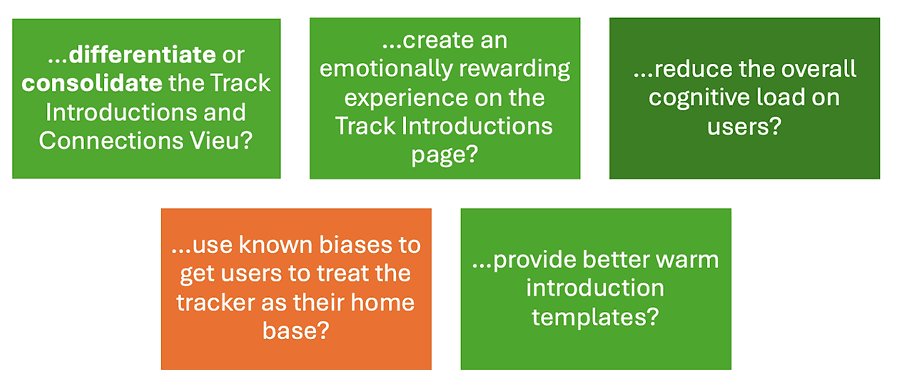
Different How Might We Statements I proposed to the Head of Design.
After discussing with the Head of Design, we landed on reducing the overall cognitive load, specifically workshopping the statement in terms of accessibility:
| How might we reduce users’ overall cognitive load to increase accessibility of features within the tracking introductions page?
Uncovering the “Why”: Exploring User Motivations In-Depth:
Initial Stage:
As a part of my initial research, I:
Reviewed and analyzed employee-client sessions (i.e. demos of new features)
Viewed mouse tracking of various clients via applications such as LogRocket
In addition to this, I also conducted my own exploration of the platform in order to understand client pain points, leveraging my own inexperience to empathize with users.
Synthesis
To consolidate the information, I built an empathy map and general user persona with some of the most recurring themes and comments observed in interviews:
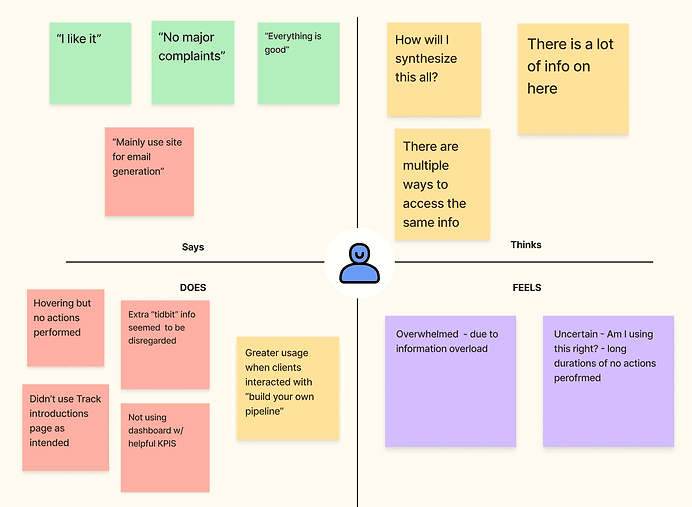
These conflicting notes suggested that driving cause for the inertia experienced by clients during site visits, causing unwanted friction with the user was most likely inattentioal blindness – they didn’t truly understand how to use the platform to its fullest extent.
First Challenge:
To validate my analysis, I crafted a user survey to send out to applicants. Unfortunately, after hand-off, due to external factors such as unwillingness to fill out the survey, I was unable to perform analysis on client feedback.
Ideation and Brainstorming for a Resolution:
One of the most critical recommendations I made was to implement minimization options for each column of information in the table-like view of the track introductions page. Minimizing would allow the non-minimized columns to become bigger, placing more emphasis on actual connections between people than on the other supplementary information.
Final Handoff:
Rooting my theories with research in applied psychology, I crafted and formed a thesis in which I bridged the gap between cognitive psychology and effective web design concepts to explain the need for not only integrating a minimalistic anchor page for administrative pages, but also the need for improving language and jargon to boost trust and usage of their existing email templates.